English Tuition for International School Students in HCMC | Spark
English Tuition for International and Bilingual School Students in HCMC: A Parent's Guide
If your child attends an international or bilingual school in Ho Chi Minh City, English is not just a subject. It is the language they are graded in across every other subject. Strong English means a child who can follow lessons in math, science, humanities, and the arts, who can write essays that the school accepts, and who can express themselves clearly in class. When English progress slows, everything else slows with it.
At Spark English Center Vietnam in Thao Dien, we work with families from BIS, ISHCMC, EIS, AIS, BVIS, the German School, Aurora, Anne Hill, the bilingual schools across District 2, and parents whose children are joining the international school system from Korean, Japanese, Vietnamese, and other Asian school backgrounds. We are an English specialist, not a general-purpose academic enrichment center. Our job is to make sure your child reads, writes, speaks, and listens in English at the level their school expects, and at the level their future university entrance will demand.
This guide is for parents who are deciding whether their child needs additional English support, what kind of support actually helps, and how to evaluate the options available in Thao Dien and across HCMC. It is long because the question is not simple. We have written it the way we would explain it to a parent who walked into our center and asked. If you prefer to jump to a specific question, the section headings below act as a table of contents.
A note on what this guide is not. It is not a sales pitch. We will be honest where Spark is the right answer and honest where another option is better for your child. International school families in HCMC are sophisticated buyers and deserve the truth more than the marketing.
Why English support matters more for international school students than parents often realize
At an international school, English is the medium of instruction. A child who is one CEFR level behind their grade is not a child who is slightly weak in one subject. They are a child who is operating below the threshold needed to understand math word problems, write science lab reports, take part in humanities discussions, and produce the extended writing that IB and IGCSE assessments require.
This is the gap parents often miss. Schools track English progress in their EAL (English as an Additional Language) reports, but those reports tend to focus on conversational ability and basic comprehension. Academic English (the English of textbooks, essay structure, subject-specific vocabulary, and exam writing) develops on a different timeline and is harder for parents to evaluate from the sidelines.
A child can sound fluent in English when chatting with friends and still be quietly behind in academic English. They are two different skills. The first develops in roughly two years of immersion. The second can take five to seven years to fully reach grade-level expectations, even for perfectly bright children. International school teachers know this. They build their lessons assuming children will catch up. But "catching up" only happens reliably if the underlying language work is being done somewhere, by someone who knows what the child needs at each stage.
Who Spark is for
We work with three main groups of families.
International school families
Children attending fully English-medium international schools in HCMC. The largest group is at the schools clustered in Thao Dien: BIS HCMC, ISHCMC, EIS HCMC, AIS Saigon's Thao Dien campus, the German School, Aurora School, Anne Hill, and the smaller boutique schools in the area. We also serve families whose children attend BVIS, AIS Thu Thiem, Saint Ange, La Petite Ecole, and the broader cluster of schools across District 2 and Thu Duc City. Tuition fees at these schools range from roughly 250 million VND to over 700 million VND per year, which makes the investment in English support a small fraction of the total but a meaningful one for academic outcomes.
What these families typically need: targeted academic English to keep pace with curriculum demands, structured writing development, exam preparation for IGCSE and IB, and a steady second voice that knows how the school grades and what is coming next.
Bilingual school families
Children attending the bilingual schools across HCMC, where English is a major part of the curriculum but not the sole medium. Families at Vinschool, VAS, Wellspring, the IGCSE-track bilingual programs, and similar schools come to us when school-side English support is not enough to lift their child to the academic level they want for university entrance and international study.
What these families typically need: stronger academic English alongside the school's curriculum, deliberate IELTS or Cambridge English preparation timed correctly to the child's development, and confidence-building in writing and speaking.
Transitioning families
Families whose children are moving into the international school system from Korean schools, Japanese schools, Vietnamese local schools, or international schools in other countries. The window between deciding to transition and the start of the new school year is often three to six months, and families need a structured English program in that window.
What these families typically need: a calibrated English bridging program, preparation for the international school's English entrance assessment, and a clear understanding of what level their child will need to function in their new classroom.
What we teach: the Phonics to IELTS pathway
Spark's curriculum is built as a single coherent pathway from early literacy to exam readiness, anchored in CEFR. We use CEFR (the Common European Framework of Reference) as our progression backbone because it is the international standard that maps cleanly onto Cambridge English Young Learners, IGCSE English, IB English, and IELTS. Most parents have never had CEFR explained to them properly. We have a separate guide for that. The short version: CEFR has six levels, A1 through C2, and your child should be progressing through them at a rate appropriate to their age and school context.
Phonics and early literacy (typically ages 5 to 8, CEFR pre-A1 to A1)
Children entering the international school system at age 5 to 7 need a systematic phonics foundation. Reading does not happen by accident, and a child who has not learned to decode English words systematically will struggle to keep up with the volume of reading their school requires. We teach systematic synthetic phonics aligned to international school expectations, with regular reading age assessment and decoding practice in small groups where every child has time to read aloud and be heard. Our Phonics Superpower program is also available as a downloadable parent guide for families who want to support phonics work at home.
Foundation academic English (typically ages 7 to 10, CEFR A1 to A2 / B1)
This is where the move from learning to read to reading to learn happens. We work on reading comprehension, vocabulary depth, sentence and paragraph writing, listening for academic content, and speaking with structure. Our students at this stage are typically Year 2 to Year 6 in their international or bilingual school. We coordinate, where possible, with the curriculum the school is using, so the work feels coherent rather than parallel.
Intermediate academic English (typically ages 10 to 13, CEFR B1 to B2)
This is the stage at which many students plateau if their foundation was conversational rather than academic. We focus on essay structure, paragraph development, analytical reading, vocabulary for subject content, and the speaking confidence that lets a student participate in class discussions. For students preparing to enter IGCSE in Years 9 to 11, this is the stage that makes the difference between scraping a B and earning an A.
IGCSE English and IB English preparation (typically ages 13 to 16, CEFR B2 to C1)
We prepare students for IGCSE English (both First Language and Second Language pathways), IGCSE English Literature, and the entry-level work for IB English Language and Literature and IB English B. This is where curriculum-specific knowledge matters: knowing exactly what an IGCSE examiner is looking for, what a strong Paper 2 essay looks like, and what differentiates a 6 from a 7 in IB English. Our teachers work with these specifications as their daily reference. We do not approach exam prep as a separate domain disconnected from language. Strong language work is the foundation; exam-specific technique sits on top of it.
IELTS preparation (typically ages 14+, CEFR B2 to C1+)
Because IELTS is built on the same CEFR foundation as the rest of our curriculum, our students arrive at IELTS preparation with the language already in place. Our role at this stage is exam strategy, time management, task-specific writing technique, and the listening and reading practice that lifts a student from a 6.5 to a 7.5. We are deliberate about timing here. The Vietnamese cultural pressure around early IELTS (the "IELTS juniors" phenomenon) can push children into preparation that is not developmentally appropriate. We will tell you honestly when we think your child is ready and when we think waiting six months will produce a stronger result.
What makes Spark different from other English centers in HCMC
There are dozens of English centers across HCMC, from the large chains (ILA, Apollo, VUS, British Council, Wall Street English) to private tutors working out of their apartments. Most of them are excellent at what they do. But almost none of them are designed for international and bilingual school children specifically. Here is what is structurally different about Spark.
Maximum class size of six, by design
Every class at Spark caps at six students. This is not a marketing claim. It is the structural decision that everything else flows from. With six students, a teacher can give every child meaningful speaking time in every session, can read every piece of writing carefully, can spot a misunderstanding the moment it happens, and can group children by genuine ability rather than by registration date. We have written a separate piece on the research and the trade-offs of class size at this level. The short version is that six is the maximum size where peer learning and individual feedback both work fully. Larger classes lose the feedback density. Private one-on-one loses the peer dynamic. Six is the size where both are present.
Diagnostic grouping
Every child who joins Spark starts with a free assessment. We assess reading age, vocabulary range, writing development, listening comprehension, and speaking confidence separately, because these skills do not develop at the same rate in the same child. Our grouping is then based on the actual diagnostic profile, not on age or school year. A Year 5 child whose reading age is two years above their grade but whose writing is at grade level will be placed differently from a Year 5 child with the inverse profile. This is only possible because our class size is small enough to make differentiated grouping work.
Specialist teachers, not generalist instructors
Our teachers are English specialists with experience in international school environments. They know what an IB examiner expects, what an IGCSE rubric values, what reading age looks like at each stage, and how the silent period and plateau effect actually play out in real children. Mr Joe Evans, who leads our IELTS and IB English work, has detailed credentials on his bio page. Kathryn, who leads our ESL and IB English program development, has her own teaching specialism that we describe on her page. We are not a center that hires anyone with a TEFL certificate. We are a small specialist team, by design.
Transparent pricing
Almost no English centers in HCMC publishes its prices. We do, on our pricing page. The reason is simple: parents making a decision this consequential deserve to compare options without having to sit through a sales call to find out what something costs. Our pricing reflects what small-group instruction with specialist teachers actually costs to deliver well. We are not the cheapest option in HCMC, and we are not trying to be. We are the right answer for families who want serious English work done seriously.
Honest editorial voice
We do not promise band-score increases that no center can guarantee. We do not claim our methods are ten times better than the next center's. We do publish our outcomes data on our outcomes page, with the privacy considerations parents would expect. The voice you are reading on this page is the voice we use throughout: warm, direct, evidence-led, parent-respectful. If that does not sound like the kind of English center you want, we are probably not the right fit.
How parents know their child needs English support
Most international school parents come to us when they have already noticed something. The common signals, in roughly the order they tend to surface:
The school report shows English at "below expectations" or "needs additional support." This is the clearest signal. Schools do not flag this lightly, and parents should treat it as a genuine prompt to act, not as a passing comment.
Reading age has fallen behind grade level. International schools test reading age at intervals using standardised assessments. A child who is six months to a year below their grade-level reading age can usually catch up with structured support. A child who is more than a year behind needs intervention.
Writing has plateaued. The child can produce sentences but not paragraphs, or paragraphs but not structured essays. This is often the first sign that a child has hit the academic English plateau we mentioned earlier. It is also the most common complaint we hear from parents whose children have been at large-chain English centers for two or three years.
Speaking confidence has dropped. A previously chatty child has become quieter in class, reluctant to speak in English socially, or anxious about oral presentations. This is sometimes a normal silent period, sometimes a confidence issue, and sometimes a deeper academic English gap that the child can feel, even if they cannot articulate it.
Subject grades are dropping in subjects taught in English. This is the late signal. By the time a child's math or science grades drop because their English is not strong enough to access the subject content, the gap has been there for a while. We see this often when families come to us for the first time at age 11 or 12.
The child says they hate English. This one is worth taking seriously rather than dismissing as a phase. It usually means the child is struggling in a class that is not differentiated for them, or in a setting where they feel exposed.
Our blog covers each of these signals in more depth, with diagnostic guidance for parents. The most useful starting point is our "My child is struggling with English at international school" piece, linked from the resources hub.
How Spark works in practice
Step 1: Free diagnostic assessment
Every family begins with a free assessment at our Thao Dien center. This takes around 60 to 90 minutes. We assess reading age, vocabulary, writing, listening comprehension, and speaking. The output is a detailed profile showing your child's strengths and gaps across the five skill areas, with our recommendation for placement and program. If we recommend that your child does not need outside English support right now, we will tell you. We have turned families away when their child was simply going through a normal silent period or when the school's own EAL program was already well-suited to their needs.
You can book a free assessment at sparkvn.com/Assessment.
Step 2: Placement and program selection
Based on the assessment, we recommend a program: Phonics, Foundation English, Intermediate English, IGCSE Preparation, IB English Preparation, ESL, or IELTS Preparation. We also recommend a class size grouping. The standard is a small group of up to six. For children with very specific needs (early dyslexia work, advanced acceleration), we sometimes recommend a smaller cluster of three or one-to-one work. We will tell you which option suits your child and why.
Step 3: Sessions at Thao Dien
Sessions run after international school hours and on weekends. Most students attend two 90-minute sessions per week. Our center is in Thao Dien, within walking or short driving distance of the major international schools in the area. We deliberately do not have multiple branches. One specialist center, well-staffed with consistent teaching, produces better outcomes than a chain of locations.
Step 4: Progress reporting
Every student receives written progress updates every six weeks, with reading age, writing development, vocabulary growth, listening progress, and speaking confidence tracked separately. Parents receive these reports directly. We do not use vague summary language. The reports are specific enough that you can take them to your child's school teacher and have a constructive conversation.
Step 5: Annual review
At the end of each academic year, we sit down with each family for a structured review and a recommendation for the year ahead. Sometimes the answer is "continue with the current program." Sometimes it is "your child is ready to move on from Spark, here is what we would do next." We are not trying to keep families at Spark indefinitely. The goal is to get your child to where they need to be and then let them keep going.
Frequently asked questions about Spark and English tuition for international school students
The questions below cover what parents most often ask before booking an assessment. The Duda Accordion widget houses these on the live page with FAQ schema enabled. The full set is also useful as standalone content for AI tools and parents skimming the page.
Q: How is Spark different from ILA, Apollo, VUS, or British Council?
A: The big chains are excellent for general English education and are the right fit for many Vietnamese families. They are not designed for international or bilingual school children specifically. Their classes are larger, their curriculum is built for general English progression rather than for keeping pace with international school requirements, and their teachers are not typically IB or IGCSE specialists. Spark is built for international and bilingual school families, with class sizes of six, specialist teachers, and a curriculum aligned to CEFR and international school expectations.
Q: My child is at BIS or ISHCMC. Do they really need outside English support if the school has EAL?
A: Sometimes yes, sometimes no. School EAL programs are well-designed for general English support, but they have to serve large groups of children with different needs. If your child has been in EAL for more than a year and progress has slowed, or if their academic English is not keeping pace with curriculum demands, outside support is worth considering. Our free assessment will tell you honestly. We have turned families away when EAL alone was sufficient.
Q: What is the difference between Spark and a private one-on-one tutor?
A: Private tutors give individual attention but no peer dynamic, no curriculum coherence, and often no progression structure. Children at Spark are in classes of six, which gives them genuine speaking practice with peers, exposure to other children's thinking, and the social motivation that helps language acquisition. We have a longer piece comparing the two options, linked from our blog.
Q: What level of English does my child need for an international school entrance assessment?
A: It depends on the school and the year of entry. Most international schools test reading, writing, and speaking, with the bar rising at later years of entry. Schools also assess for academic readiness, not just conversational fluency. We have prepared children for entrance assessments at BIS, ISHCMC, EIS, AIS, BVIS, the German School, and other schools in HCMC. Our free assessment includes a discussion of what your specific target school will be looking for.
Q: When should my child start IELTS preparation?
A: Honestly, often later than parents in Vietnam assume. The IELTS-juniors trend pushes children into preparation that is not developmentally appropriate. For most international school students, the right time is the year they need a band score for university applications, not five years before. We have a separate, evidence-led piece on this question. We will tell you honestly when your specific child is ready.
Q: Do you teach IB English Language and Literature, or IB English B?
A: Both. The two pathways serve different students. IB English Language and Literature is for students who are at a near-native level. IB English B is for students for whom English is an additional language. We work with families to identify which pathway suits their child and prepare accordingly. Kathryn leads our IB English program development.
Q: We are moving to HCMC in three months, and our child needs English preparation before starting at an international school. Can Spark help?
A: Yes. Transitioning families are one of our three core groups. We run intensive bridging programs designed for the three to six-month window before a child starts at a new international school. The program is calibrated to the entrance level of the specific target school and includes the academic English foundations they will need from week one.
Q: My child is dyslexic. Is Spark suitable?
A: Spark is well-suited for children with mild to moderate dyslexia who benefit from structured, systematic phonics work. Our small class size means we can adapt the pace and approach to your child's needs. For more complex, specific learning needs, we work alongside specialists; we will tell you honestly during the assessment whether we are the right primary support or whether your child would be better served by a specialist intervention with us as a complement.
Q: Do you offer sessions in Vietnamese as the first language of instruction?
A: No. Our sessions are conducted in English. We have Vietnamese-speaking staff for parent communication, and we welcome Vietnamese, Korean, Japanese, and other native language speakers among our students, but the language of instruction is always English.
Q: Where is Spark located?
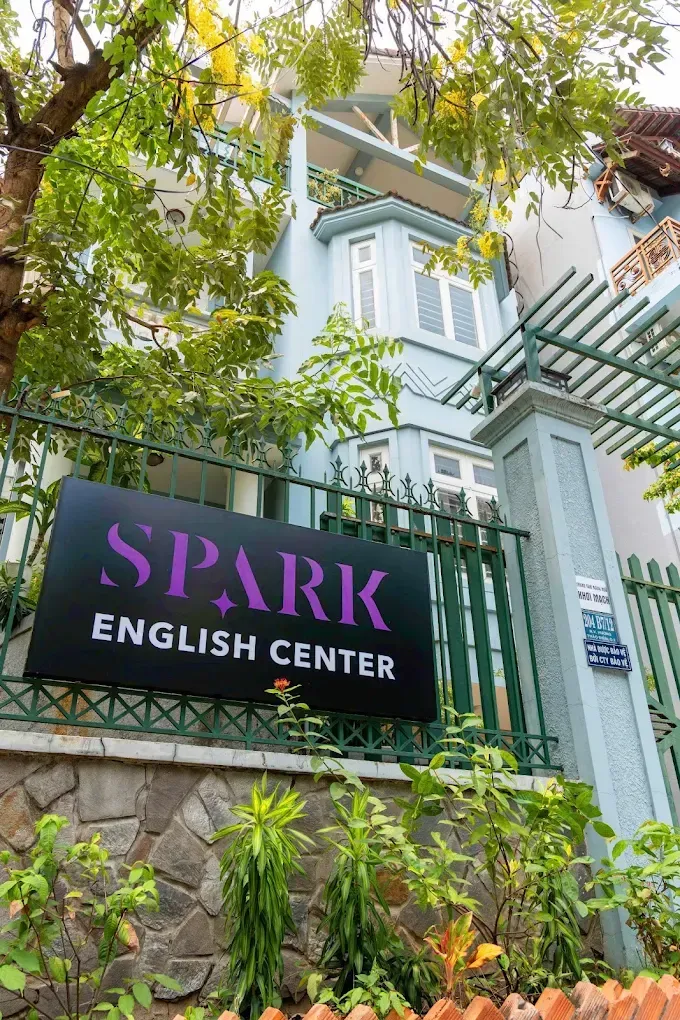
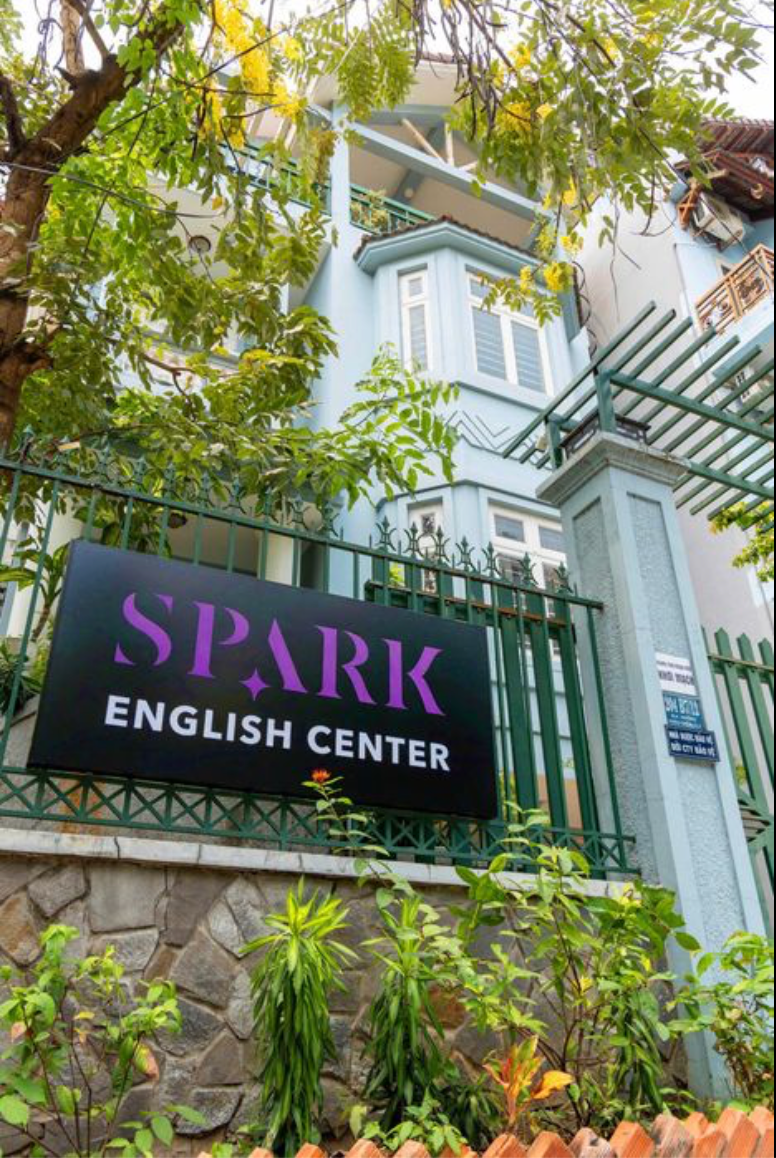
A: Spark English Center Vietnam is located in Thao Dien, District 2 (Thu Duc City), HCMC. We are within walking or short driving distance of BIS HCMC, ISHCMC, EIS HCMC, AIS Saigon's Thao Dien campus, the German School, Aurora School, Anne Hill, and many of the bilingual schools across the area. Our complete address and directions are on our contact page.
Q: How much does Spark cost?
A: We publish our prices transparently on our pricing page. We are not the cheapest option in HCMC. We are priced to deliver small-group specialist instruction sustainably, and we believe families deserve to see the cost before booking an assessment.
Q: How do I book an assessment?
A: Book a free assessment at sparkvn.com/Assessment. The assessment takes 60 to 90 minutes, includes a detailed report on your child's English profile, and there is no obligation to enroll afterward.
Ready for the next step?
If your child needs English support and you would like to know what kind of support actually fits, the most useful next step is a free assessment. We will give you a clear, specific picture of where your child is across the five skill areas and what the right path forward looks like. Whether that path is at Spark or somewhere else, you will leave with a sharper understanding than you walked in with.
Book your free assessment at sparkvn.com/Assessment.
Related reading
- Why class size matters for English learning at an international school (Pillar 2)
- CEFR levels for international school children: a parent's guide (Pillar 3)
- How to choose an English center for your international school child: an honest guide (Pillar 4)
- Spark and the Thao Dien international school community (Pillar 5)
- My Child Is Struggling with English at an International School: A Parent's Guide
- Moving to an international school in HCMC: preparing your child's English
- When should my child start IELTS preparation? An honest take